
We are delighted to have been recognised as a winner in the 2026 Luxuri Awards, celebrating excellence in modern luxury, craftsmanship and design. To mark the occasion, Luxuri invited us to share the Martin Moore story, from the first kitchen created by Martin and Barbara Moore in 1975 to the bespoke furniture we now design for spaces throughout the home. Here, the magazine explores the principles that have shaped our work for more than 50 years and continue to guide its next chapter.
In 1975, Martin and Barbara Moore were renovating their Victorian home when they encountered a problem that was at once ordinary and oddly difficult to solve. They could find kitchens, certainly, but not one that felt right for the house they were trying to make for their young family. Much of what was available followed the prevailing German and Italian idiom; the alternative was to compromise either the room or their idea of how they wanted to live in it. They chose neither. Instead, they made their own. That first kitchen became the beginning of Martin Moore, but it also established the instinct that would shape the business: start with the house and the life within it, then make the kitchen belong to both.
Half a century later, the kitchen remains at the centre of Martin Moore’s reputation, but the furniture-making discipline behind it is travelling further through the home. As kitchens have become more open and more social, pantries, boot rooms, back kitchens, utilities and wine rooms have taken on more considered roles around them. Martin Moore’s brief has widened accordingly, applying the same bespoke approach that shaped its kitchens to the rooms that now support and complement them. Yet the question confronting each commission is remarkably close to the one that started everything in 1975: how should each room work for the life being lived in it, and how can the furniture continue to feel right as that life changes?
Fifty years after Martin and Barbara Moore made their first kitchen, the room itself is doing a different job. In many of the homes Martin Moore now designs, it is no longer simply where food is prepared, but where people gather, talk and entertain, often in full view of the rest of the house. The kitchen still has to work hard, but it also has to sit comfortably among furniture, art and architecture.
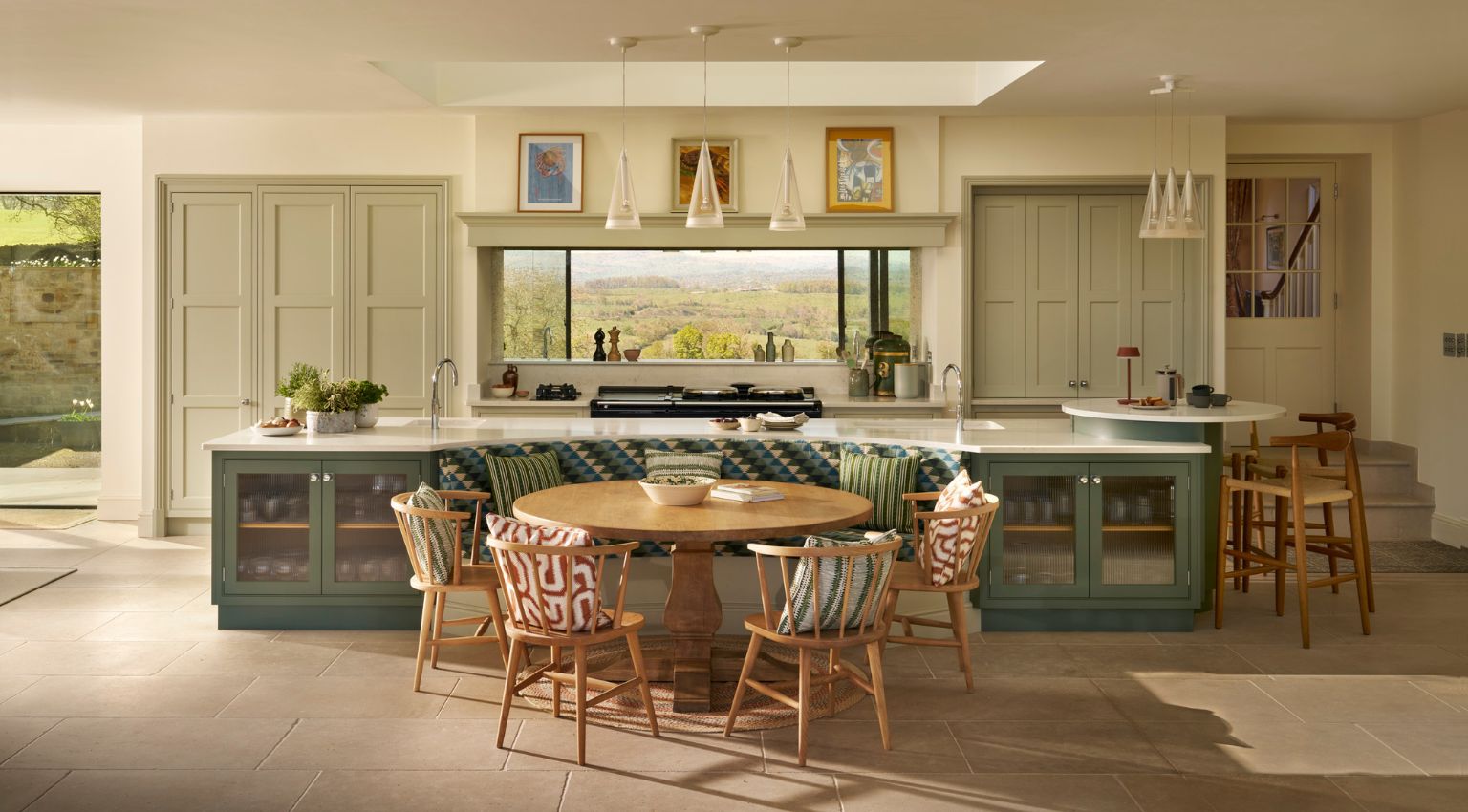
Martin Moore’s 2026 kitchen for WOW!house captures that shift. “Fumed oak”, stone and curved cabinetry give the room the presence of a principal living space, while breakfast equipment can disappear behind closed doors when the morning is over. The kitchen is not disguised so much as edited: what deserves to remain in view does, and the rest is given somewhere else to go. That is where bespoke becomes more than a luxury adjective. Martin Moore’s collections are starting points rather than fixed systems. Cabinets are made to the dimensions of the room and hand painted on site, allowing the architecture to shape the kitchen rather than the reverse. The point is not endless choice, but fit: the kitchen should feel particular to the house and the life within it.
As the kitchen has become more social, other rooms have become more purposeful. Pantries, back kitchens, boot rooms and utilities are returning because they take on the work a more visible main room no longer needs to carry.
One Martin Moore commission in Cheshire makes the logic tangible. Beyond the principal kitchen sit a scullery, catering kitchen, boot room, utility, laundry, office, orangery and guest kitchenettes. The rooms are connected, but not copied. A bar can afford theatre; a utility room needs order. What travels through the house is not one repeated look, but a shared discipline of proportion, material and making.
That distinction matters. Martin Moore’s description of itself as a cupboard maker does not diminish the kitchen; it explains how the expertise behind it can move through the home without turning every room into another kitchen. The pantry, boot room or wine room can keep its own character while still feeling as though it belongs to the same house.
That wider brief gives Martin Moore’s fifty-year history more weight than an anniversary alone. Furniture made for a significant home has to live through changes no designer can fully predict. Families change. Technology changes. Rooms acquire different uses.
Martin Moore still makes its furniture to order in Yorkshire, controls installation closely and hand paints on site. It offers a lifetime guarantee, while older kitchens can be repainted, renovated or extended rather than automatically replaced. Those details give substance to a word luxury brands often use too easily: timeless.
The point is not that a Martin Moore kitchen should look unchanged for decades. Its four WOW!house kitchens suggest the opposite. Materials, forms and ways of living move on. What endures is the discipline beneath them: proportion, craftsmanship and the expectation that the furniture should remain worth keeping.
Martin Moore is now carrying that approach further through the home, while building deeper relationships with architects, interior designers and developers across Britain and Europe. The kitchen remains the centre of its reputation, but increasingly it is also the point from which a larger conversation about the house begins.
That shift feels less like expansion for its own sake than a return to the instinct that started the company. In 1975, Martin and Barbara Moore made one kitchen because they could not find anything that felt right for their own home. Half a century later, Martin Moore, now with their sons Richard and Mike at the helm, is being asked to make that same judgement across pantries, boot rooms, utilities, wine rooms and the spaces that gather around the kitchen.
The brief is wider now, but the measure is remarkably similar. A room should work beautifully for the life taking place within it, and feel sufficiently at ease in the house that it never appears imposed upon it. For Martin Moore, that may be where the next fifty years begin: not by moving away from the kitchen, but by allowing the thinking that shaped it to travel further through the home.
Share
