
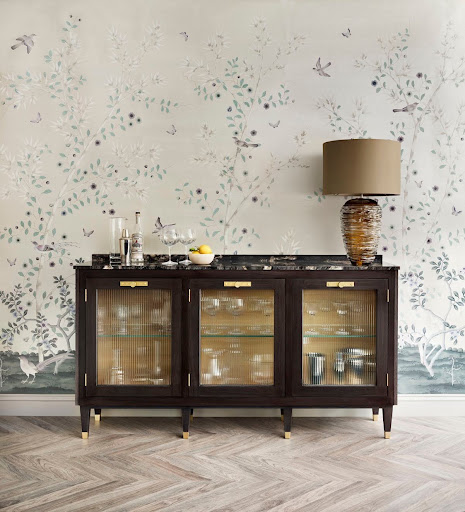
The kitchen has become one of the most considered rooms in the home, a space where cabinetry, furniture, lighting, art and decorative finishes come together as part of a wider interior scheme. Wallcoverings can play an important role within this, introducing colour, pattern and texture while giving the room a character that feels particular to the people who live there.
For us, the most successful kitchens are those in which every element has been considered as part of the whole. Just as the colour of hand painted cabinetry might respond to a particular stone or timber, a wallcovering can draw together different materials, complement the architecture or introduce an expressive counterpoint to a more restrained scheme.
Increasingly, there is also an opportunity to use wallcoverings beyond the kitchen’s principal working areas. Breakfast nooks, dining spaces, banquettes and adjoining rooms lend themselves particularly well to decorative treatments, while bespoke designs can be tailored around cabinetry, doors, windows and other architectural details.
To explore how to use wallcoverings successfully in a kitchen, we spoke to Fromental, whose hand painted and hand embroidered wallcoverings combine traditional craftsmanship with highly individual design. From choosing pattern and colour to understanding the practical considerations of using delicate materials within a hardworking room, the Fromental team share their advice.
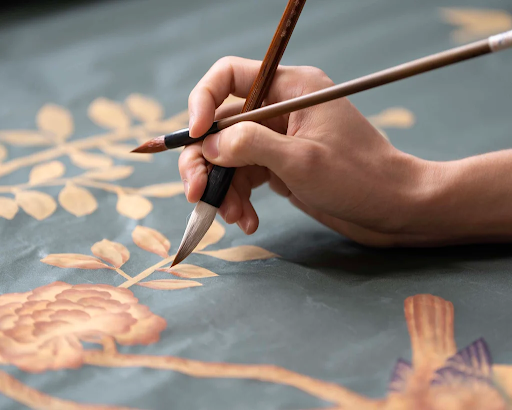
Image courtesy of Fromental
Bespoke wallcoverings are naturally complementary to bespoke kitchen schemes. Designs can be tailored to the architecture and materials of the space, thus creating an interior that feels truly personal and considered.
Wallcoverings work beautifully in breakfast nooks, dining areas and less exposed walls, where they can create a focal point or a sense of intimacy. Behind open shelving or within a framed architectural panel, they can also introduce a decorative detail that feels integral to the design.
Begin with the atmosphere you want to create. Consider how the kitchen will be used, the materials already specified and how the space connects to adjoining rooms. From there, colour, pattern and texture can be explored to create a scheme that feels cohesive yet distinctive.
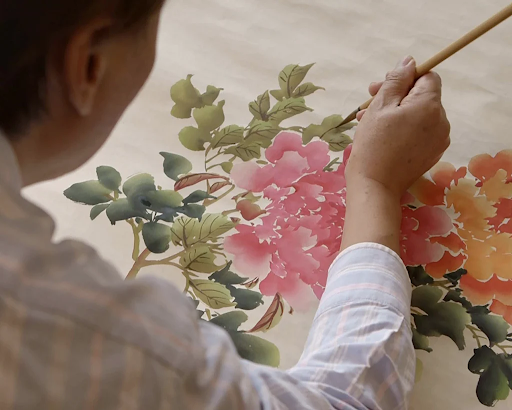
Image courtesy of Fromental
Look for a point of connection, whether that is a subtle undertone in the stone, the warmth of the timber or a complementary shade within the cabinetry. Rather than matching everything exactly, favour considered contrasts and a dialogue between materials, allowing each element to retain its character.
A large-scale design can be wonderfully effective when given space to breathe. Restricting it to a single wall, dining alcove or carefully defined area allows the pattern to become a focal point. A restrained palette and simpler surrounding materials can help balance a more expressive design.
Light has a significant influence on how colour and texture are perceived. In darker kitchens, lighter grounds and reflective details can bring a sense of luminosity, while deeper tones create warmth and intimacy. In rooms with generous ceiling heights, larger-scale patterns can feel particularly at home; smaller spaces often benefit from designs that create rhythm and a sense of movement.
The positioning of the wallcovering is key. We recommend avoiding direct exposure to cooking splashes, excessive steam and sources of heat, particularly around hobs and sinks. Adequate ventilation and appropriate extraction are important, and the intended location should always be considered fully before specification.
The choice should reflect the level of exposure and the practical demands of the space. Silk and other delicate materials are better suited to areas with less humidity for example.
As early as possible, ideally during the initial design and material-selection stage. Considering the wallcovering alongside cabinetry, stone, lighting and flooring allows the whole scheme to develop cohesively and ensures that architectural details and pattern placement are properly planned.
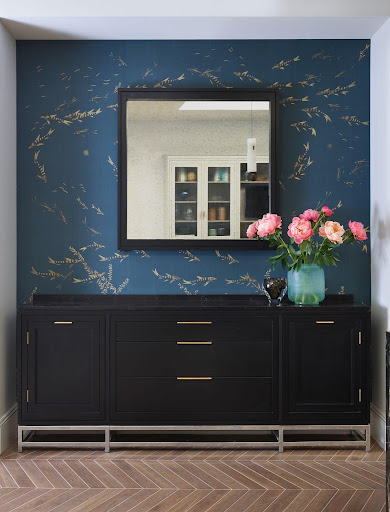
Bespoke design allows the pattern to respond to the architecture rather than simply accommodate it. At Fromental, designs can be adapted in scale, composition and colour, with motifs positioned to work around windows, doorways and cabinetry. This creates a more considered, integrated result in which the wallcovering feels tailored to the room.
We believe timelessness comes from choosing designs with depth and integrity rather than following a passing trend. Nature-inspired motifs, considered colour palettes and traditional craftsmanship can feel enduring while still bringing individuality to a space. A wallcovering should ultimately reflect the homeowner’s personality and be something they continue to enjoy living with over time.
At Martin Moore, we approach colour, material and decoration as part of the kitchen design from the outset. Whether a wallcovering provides a subtle backdrop or becomes a defining feature of the room, considering it alongside the cabinetry, stone, flooring and lighting creates opportunities for a more cohesive and individual interior.
As Fromental’s advice demonstrates, there is no need for a kitchen wallcovering to be purely decorative. When its scale, position and palette respond to the architecture and the materials around it, it can become an integral part of the room.
Read more about Designing a statement kitchen in our recent article.
Share
